As an electrician, test technician, or electrical worker in today’s electrified world, the need for a good quality digital multimeter, also known as a “DMM,” isn’t a luxury but a necessity. Choosing the right one can help you complete your job efficiently by capturing accurate data, but selecting the wrong type, using it improperly, or not understanding its limitations or ratings can have a negative impact on your personal safety. While DMMs are incredibly useful tools that help us quickly find the problem during troubleshooting, diagnostics, and data gathering, they also pose significant risks to the user.
For this reason, OSHA safety regulations and NFPA® 70E®, Standard for Electrical Safety in The Workplace® limit the use of test instruments to only qualified electrical persons. Training, followed by the worker’s ability to demonstrate the learned skills, is what separates a qualified electrical person from an unqualified electrical person. The governances require qualified persons to “be trained to select the appropriate test instrument and shall demonstrate how to use the device… The employee must understand all limitations of each test instrument that might be used.”
This mandate for safety training of qualified electrical workers validates the extreme hazards when using test equipment or instruments on live circuits. We will discuss the training element in greater detail later in this article.
As the name “multimeter” implies, these test instruments provide a multitude of helpful functions, compared to a standard analog or digital voltmeter (VM) or the old volt ohmmeter (VOM). Additional features can include the ability to read current, resistance, continuity, capacitance, frequency and several other electrical values.
In former years, specialized individual test instruments were needed to ascertain each of these factors, but with the modern DMM, many of these important functions are wrapped up in a single portable device. The different settings are normally set with either a rotary dial and/or push buttons.
Reading Voltage Vs Reading Current
Most high quality DMMs from reputable manufacturers, when placed in the voltage setting, normally have high input impedance or “High Z” in the range of 10MΩ (10,000,000 ohms). The high internal impedance limits the magnitude of current through the meter to microamps (µA) which allows voltage checks of sensitive control, signal, and data circuits without inserting an external burden into the circuit which can result in unintentional trips or bringing in alarms.
Low impedance or “low Z” meters are also available. They normally have internal impedance around 2 to 10 KΩ (2000 – 10,000 ohms) or less, such as those with electromagnetic coils. However, cheap budget DMMs normally have substantially low input impedance as well. Such low impedance meters, when placed in parallel, can draw a significant amount of current from sensitive circuits causing equipment actuations, alarms and other undesirable effects on SCADA (system control and data acquisition) or similar systems.
If you recall from your electrical theory classes, in a parallel circuit, current divides proportionally through each parallel branch based on the resistance in the individual branches. Figure 1 depicts the voltmeter (inside red box) placed in parallel across a resistance to read the voltage drop across the resistor. The extremely high impedance of the DMM only permits a minute amount of current through the DMM while providing accurate voltage reading.
Fig. 1 – DMM Used as a Voltmeter is in Parallel with the Circuit
Choosing between a good quality High-Z or Low-Z DMM is mainly determined by type of circuits you’ll be testing. For signal, alarm, and sensitive control circuits, High-Z DMMs are the best choice. However, either type (High-Z or Low-Z) is suitable when checking voltage of standard power circuits as long as the DMMs are manufactured from quality companies, carry a certification, and are used in accordance with their safety instructions.
Plugging Test Leads into the Wrong Ports is Hazardous
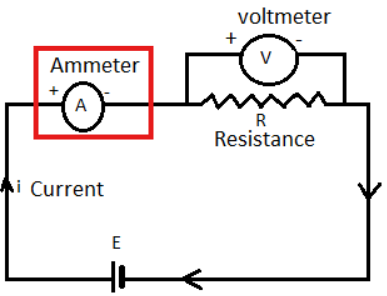
While high quality High-Z and Low-Z DMMs have significant impedance, this can be easily bypassed by simple mistakes. Many DMM models have three or four female ports, increasing the chances of making this error. A common and dangerous error when using a DMM is placing it in the wrong configuration to perform a function it was not designed for, i.e., intending to take voltage readings but plugging the leads into the current port jacks. To read current, the DMM (inside red box) as shown by Fig. 2, must be used as an ammeter by connecting it in series with the circuit.
Fig. 2 – DMM Used as an Ammeter is in Series with the Circuit
Drawing again from our understanding of basic electrical theory, the current remains the same in a series circuit but has a voltage drop across each resistor which equals the total voltage applied to the circuit. When inserted into the ports designed for current, the internal impedance of the DMM is reduced to near zero in the range of 0.05 ohms. So, when it’s connected to a circuit to read voltage, this results in a short circuit through the meter and leads.
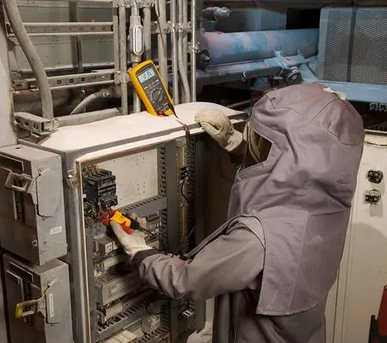
Fig. 3 shows this common mistake where the black test lead is in the “COM” jack port and the red test lead is plugged into the current jack port marked “A” while the meter is set for ac voltage. Many high quality DMMs, like the one displayed, will provide a visual and audible indicator to warn of this dangerous error; in this case, the word “LEAD” is displayed on the digital screen and an alarm can be heard.
But beware, this built-in safety feature of a dangerous condition is not integral to all DMMs, especially those cheap models purchased at budget prices or from questionable companies.
Fig. 3 – DMM Set for AC Voltage but Red Lead is Plugged into Current Port
Good quality DMMs from reputable manufacturers also have internal protection to mitigate the severity of this mistake, consisting of specialized “high energy” sand fuses with very high current interrupting capacity in the range of 10 – 17KA and a voltage rating of 1kV. This type of specialized fuse will contain the heat and pressure energy within the fuse body without catastrophic failure, which prevents injury to the user and damage to the DMM.
If one of these specialized fuses is blown, do not replace them with a standard 300V fuse of the same physical size and current rating purchased from your local hardware store. Blown DMM fuses must be replaced with the same unique style of fuse originally installed by the manufacturer. If you’re unsure of the specific type of fuse needed, consult the user’s instruction manual or contact the manufacturer for assistance.
Cheap, low-end DMMs are either equipped with no fuse protection or have inadequate fuses which will literally explode when subjected to a short circuit involving high levels of fault current.
Jack Plug Covers Can Reduce Errors
If you have a DMM with several female jack ports, an effective way of minimizing the chances of making this error is to use rubber jack plug covers over the ports designed for current, as shown by Fig. 4. They can be easily removed if the current jacks are needed. These inexpensive and simple devices are another method to reduce human errors when using DMMs.
Fig. 4 – Rubber Jack Plug Covers
Wrong DMM Settings Can Also Compromise Your Safety
Placing your DMM in the wrong setting is another frequent error that can cause injury. Fig. 5 shows the rotary dial of an inexpensive DMM set in the 600-volt alternating current (ac) mode. As you can see, it has many different positions to choose from. Such cheap budget store DMMs may be suitable for homeowners checking single-phase 120V receptacle outlets, but they are not compatible for use in industrial, commercial or utility locations.
Fig. 5 – Rotary Dial Setting of an Inexpensive DMM
Other than the obvious safety issue of using questionable low-end DMMs when working with industrial power equipment, another safety challenge resides when the DMM is mistakenly placed in the wrong setting, such as resistance, diode, continuity, or capacitance, which are designed for use on deenergized parts and components but used on live circuits.
When inadvertently set to one of these settings, the DMM itself provides the voltage and current through its internal power supply, typically a standard 9V battery or several AA or AAA batteries. If connected to an energized circuit, it will result in a short circuit through the DMM circuitry and its battery, causing a catastrophic failure of the meter and leads. That will not only permanently damage your expensive investment at best, but it can also permanently damage you at worst by exploding in your hand.
As previously mentioned, many high quality DMM manufactured by reputable companies are equipped with specialized internal fuse protection to minimize the severity when mistakes are made, but countless others do not have this safety feature. However, even with fuse protection, your safety is at risk, which means it is imperative that you know your DMM limitations and double check that it is in the correct setting and configuration for the task you’re about to perform.
Correct AC and DC Settings Are Crucial During Live-Dead-Live Testing
Most DMMs can read both alternating current (ac) and direct current (dc) voltages, but the DMM can only provide you with an accurate value when correctly set to either ac or dc voltage to match the type of circuit about to be tested.
This is especially important when performing “Live-Dead-Live” absence of voltage testing to verify the part(s) about to be touched are in fact in an electrically safe work condition (ESWC). If the DMM is placed in the wrong setting for the incorrect type of voltage to be tested, i.e., the DMM is set for dc voltage but tests an ac circuit, the display may mislead the user into believing the circuit is deenergized while, in reality, hazardous voltage is still present. This is another common error that can cause injury for the unsuspecting or untrained worker who hasn’t been adequately trained on the DMM’s functions.
Unfortunately, when establishing and verifying an ESWC exists according to step 7 from NFPA 70E, 120.6(7), it only directs workers to test “Phase-To-Phase” and “Phase-To-Ground.” This is a significant gap in the standard, in the author’s opinion, because the word “Phase” only applies to ac, whereas dc circuits are identified only by “Polarities” or “Poles” with no relationship to a phase.
For more information on this gap with some effective bridging recommendations to compensate for this vulnerably in 70E, please refer to my white paper number ESW2023-32 titled “Is Absence of Voltage ‘Live-Dead-Live’ Testing According to NFPA 70E Adequate?” The paper was presented during the 2023 IEEE Electrical Safety Workshop (ESW) conference in Reno, NV. However, this important topic will also be available through the e-Hazard blog in the near future.
Keep It Simple If It Meets Your Need
Often, we think the more “bells and whistles” a DMM has the better and more useful it is. While this may be true for certain individuals, it may not be for every electrical worker. If your job involves performing many different testing protocols, then a DMM with multiple functions is probably right for you.
However, if your tasks are limited to voltage and current readings, “Live-Dead-Live” absence of voltage checks, or continuity, then a DMM with fixed test probes and basic functions as shown by Fig. 6 may meet all your needs. Some of the models can also read current and voltage without the need to use the test leads and probes.
Fig. 6 – DMM with Fixed Leads and Basic Functions
Therefore, the KISS principle (Keep It Simple, Silly) can apply when selecting a DMM which will further reduce risk of mistakes while providing what you need.
Beginning in Part 2 and beyond, we will start discussing some of the other safety challenges when using these amazing but potentially hazardous test instruments.
George Cole joined the e-Hazard team in 2021 as an electrical safety instructor and consultant specializing in the electric utility industry. He has worked for the largest electric utility company in Arizona for over three decades, holding various technical roles in several departments (building electrical maintenance, T & D, radio telecommunications, electric power generation, etc.). George is currently assigned to the Palo Verde Nuclear Generating Station as their electrical safety consultant and is the “Subject Matter Expert” (SME) in all matters related to electrical safety. George holds credentials as a Certified Electrical Safety Compliance Professional (CESCP) and a Certified Electrical Safety Worker (CESW) from the NFPA and serves as a member of NFPA’s Certification Advisory Group (CAG) for the CESCP and CESW. He is also a member of the Electrical Safety Industry Working Group (IWG) within the nuclear power industry, where he is considered an electrical safety expert among his peers.
Our ES&H group passed this along to everyone. I Wanted to pass along how good this article is. I was taught many times since a young age about the right and wrong ways of using meters. Starting with an old HAM operator when I was in jr high, then continuing into my foray into electron microscopy and particle accelerators. Both of which use a wide variety of currents and voltages. I was lucky to have people who were proficient and safety aware. This article does a really good job passing the most important aspects without overloading. What I really like is that is went into a little detail about WHY you do or don’t do something.
Greetings Chris
I’m glad my article has provided you and your folks with practical safety information regarding these invaluable tools which can and has caused serious injuries when not used correctly.
Part 2 just went live on June 4, 2026 with the subsequent Part 3 then Part 4 following very soon.
I’ve learned providing readers with short concise ‘bite-sized’ articles is an effectively way of communicating important information without overwhelming the reader.






Our ES&H group passed this along to everyone. I Wanted to pass along how good this article is. I was taught many times since a young age about the right and wrong ways of using meters. Starting with an old HAM operator when I was in jr high, then continuing into my foray into electron microscopy and particle accelerators. Both of which use a wide variety of currents and voltages. I was lucky to have people who were proficient and safety aware. This article does a really good job passing the most important aspects without overloading. What I really like is that is went into a little detail about WHY you do or don’t do something.
Greetings Chris
I’m glad my article has provided you and your folks with practical safety information regarding these invaluable tools which can and has caused serious injuries when not used correctly.
Part 2 just went live on June 4, 2026 with the subsequent Part 3 then Part 4 following very soon.
I’ve learned providing readers with short concise ‘bite-sized’ articles is an effectively way of communicating important information without overwhelming the reader.