Part 1 covered the different terms used by OSHA, the NESC® and NFPA® 70E® to denote essentially the same electric shock protection boundaries or distances. These are known as the Minimum Approach Distance (MAD) used by OSHA and the NESC, and the Restricted Approach Boundary (RAB) found in 70E.
In Part 2, we will delve into the specifics of the MAD and RAB.
OSHA’s Requirements to Cross into the MAD
In OSHA 1910 Subpart R and 1926 Subpart V, the Minimum Approach Distance (MAD) is defined as, “The closest distance an employee may approach an energized or grounded object.”
If you are wondering why grounded objects are included for the MAD, you are not alone. Grounded objects are relevant when utility workers are performing an activity called live-line barehand work (LLBHW). In this specialized work practice, the worker’s body is energized at the same electrical potential as the line he is touching and is sometimes compared to the concept of a “bird on the wire.”
Rather than using rubber blankets or gloves as insulation to prevent being shocked, the worker relies on highly conductive suits for his safety by maintaining an equal electric potential in his work area. Because his body is now energized, touching or approaching anything at a different potential, especially an adjacent phase or earth ground at zero volts, is extremely hazardous because current will flow between the two points resulting in an electric shock. Current only flows when there is a difference of voltage, which is the basis of equipotential zone (EPZ) grounding.
Both 1910.269(I)(3)(iii) and 1926.960(c)(1)(iii) establish two mandatory conditions before the qualified worker is allowed to penetrate the MAD with any part of his body or while holding a conductive object:
The employee is insulated from the energized part, or
The energized part is insulated from the employee
NESC Requirements to Cross Into the MAD
Likewise, the National Electrical Safety Code® (NESC) defines the MAD as “The closest distance a qualified employee is permitted to approach either an energized or grounded object, as applicable for the work method being used.” The NESC, injects the additional words missing from OSHA “as applicable for the work method being used” in its definition, which implies the use of insulation or LLBHW is included.
Section 44, Rule 441.A, lays out three conditions to violate the MAD:
The line or part is deenergized and grounded
The employee is insulated from the energized line or part
The energized line or part is insulated from the employee
The first condition of “The line or part is deenergized and grounded” is synonymous with an Electrical Safe Work Condition (ESWC) for those familiar with NFPA 70E which isn’t a phrase used by the NESC.
NFPA 70E Requirements to Cross Into the RAB
The Restricted Approach Boundary (RAB) is defined by 70E as “An approach limit at a distance from an exposed energized electrical conductor or circuit part within which there is an increased likelihood of electric shock, due to electrical arc-over combined with inadvertent movement.”
If you recall from Part 1, we explained the physical distances developed for shock protection includes an electrical component and an ergonomic component. The statement “due to electrical arc-over” in 70E’s definition is the electrical component with the “inadvertent movement” being the ergonomic component. So 70E provides us with a good understanding of the two components within its definition of the RAB.
Identical to the aforementioned mandates, NFPA 70E section 130.4(G) also establishes the same two criteria as OSHA and the NESC by stating, “No qualified person shall approach or take any conductive object closer to exposed energized electrical conductors or circuit parts than the RAB set forth in Table 130.4(E)(a) and Table 130.4(E)(b), unless one of the following conditions applies.”
The qualified person is insulated or guarded from energized electrical conductors or circuit parts operating at 50 volts or more.
The energized electrical conductor or circuit parts are insulated from the qualified person and from any other conductive object at a different potential.
But 70E doesn’t end there because it gives additional helpful guidance within its pages:
Section 130.7(D)(2) titled – ‘Barriers’ requires “any exposed part operating at 50 volts or more to be guarded by barriers or insulated by voltage rated rubber or plastic equipment to prevent unintentional contact while the employee is working within the RAB.” (emphasis added)
Furthermore, Informative Annex C – Limits of Approach states that for a qualified person to cross the RAB and enter the restricted space, they need to ‘Minimize the likelihood of bodily contact with exposed energized conductors and circuit parts from inadvertent movement by keeping as much of the body out of the restricted space as possible by using only protected body parts in the space as necessary to accomplish the work.’ (emphasis added)
This implies proactive actions must be taken by ensuring only protected body parts are allowed within the restricted space to minimize body contact with the energized parts due to inadvertent movement by the worker.
The Two Conditions to Cross the RAB/MAD are Identical
Therefore, a minimum of one of the two requirements must first be in place before a qualified worker is permitted to enter the RAB or the MAD regardless of the standard or regulation because they are identical, consisting of either of the following:
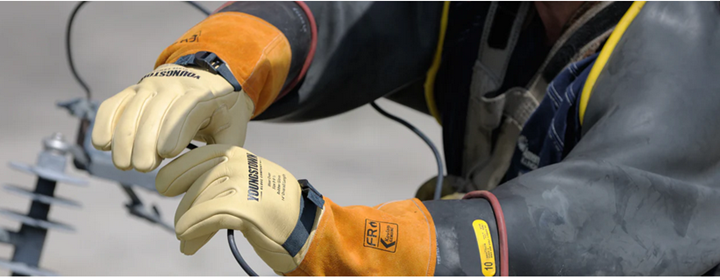
The worker must be insulated from the exposed energized part, which is normally accomplished by wearing rubber voltage rated gloves with protectors and using ASTM F1505/IEC 60900 insulated hand tools, as illustrated in Figure 3, or
The exposed energized part insulated from the worker, such as installing temporary insulating matting or blankets over the parts, shown in Figure 4.
Did you catch that last part? It is very important. Entering the RAB or MAD requires the same actions as intentionally contacting the energized parts. But the reason for the RAB or MAD is to prevent unintentional or inadvertent contact with the energized parts.
And this is where the dilemma resides with “Avoid Contact.”
However, before moving on, a note of caution is needed for the second option of insulating the worker from the energized part. The material selected to cover the exposed parts must be designed for this application. While all plastic and rubber sheeting material may be non-conductive, they cannot be used as electric insulation unless it carries a maximum voltage rating according to ASTM F1742, F2320 or D1048.
Figure 3 - Example of Insulating the Worker from the Exposed Energized Parts
Figure 4 - Example of Insulating the Exposed Energized Part from the Worker
While only one of the two is technically mandatory, we at e-Hazard always encourage employees and employers to go beyond the minimum requirements by including additional electrical safety barriers by using both rubber gloves and voltage rated insulating material whenever practical to do so. Adding a little extra safety margin in your everyday tasks only benefits you by reducing risks and increasing your chances of going home to your families at the end of the workday.
Conclusion
When we comprehend the standards in their correct context, we understand crossing the RAB or MAD is treated the same as making intentional contact with the energized part(s) for the purpose of abating inadvertent contact that can and has resulted in serious injury or death.
Part 3 will move into the details and, more importantly, the problems associated with “Avoid Contact” when it is used as the RAB and MAD.
NFPA 70®, National Electrical Code®, NEC® , 70E®, and Standard for Electrical Safety in the Workplace® are registered trademarks of the National Fire Protection Association, Quincy, MA.
George Cole joined the e-Hazard team in 2021 as an electrical safety instructor and consultant specializing in the electric utility industry. He has worked for the largest electric utility company in Arizona for over three decades, holding various technical roles in several departments (building electrical maintenance, T & D, radio telecommunications, electric power generation, etc.). George is currently assigned to the Palo Verde Nuclear Generating Station as their electrical safety consultant and is the “Subject Matter Expert” (SME) in all matters related to electrical safety. George holds credentials as a Certified Electrical Safety Compliance Professional (CESCP) and a Certified Electrical Safety Worker (CESW) from the NFPA and serves as a member of NFPA’s Certification Advisory Group (CAG) for the CESCP and CESW. He is also a member of the Electrical Safety Industry Working Group (IWG) within the nuclear power industry, where he is considered an electrical safety expert among his peers.