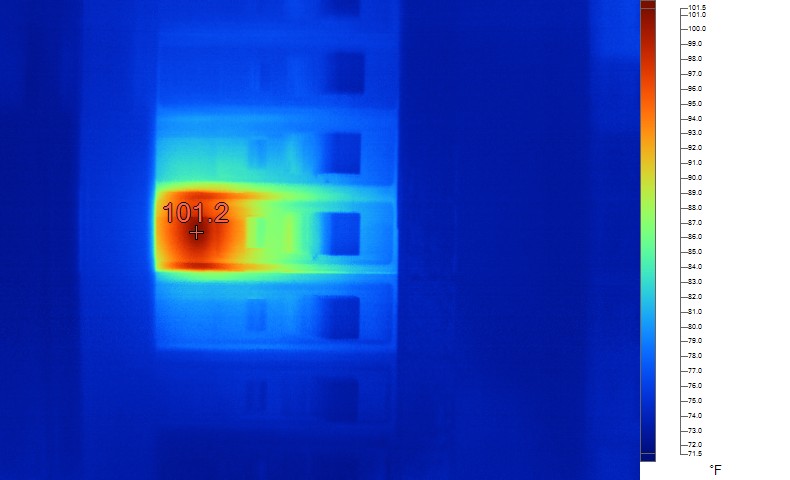
Infrared thermography has become a go-to tool in electrical maintenance. It allows us to see thermal anomalies in energized equipment often before they turn into serious problems. But here’s the big question: does a hot spot always mean failure is imminent? And can surface temperature alone really tell us how urgent a repair needs to be?
The short answer is no. The real story is more nuanced, and understanding that nuance can save money, downtime, and, most importantly, lives.
Why Temperature or Delta T Alone Doesn’t Tell the Whole Story
For years, maintenance teams and thermographers have relied heavily on surface temperature and Delta T (𝚫T) readings to judge the severity of electrical issues. While temperature is important, it doesn’t always reflect what’s happening inside a connection.
A small temperature rise might look insignificant during an inspection, but under higher loads or changing conditions, that same connection could quickly become a serious hazard. On the flip side, some connections operate at higher temperatures and remain reliable for years when stressors are low and operating conditions are stable. Temperature alone doesn’t account for these variables.
NFPA 70B: Shifting from “Find and Fix” to Risk-Based Maintenance
This is exactly where NFPA® 70B®, Recommended Practice for Electrical Equipment Maintenance® 1, becomes relevant. NFPA 70B emphasizes moving beyond reactive maintenance and adopting a risk-based approach to electrical equipment health.
Rather than treating every thermal anomaly the same, NFPA 70B encourages maintenance teams to consider operating conditions, equipment criticality, failure consequences, and historical data when determining corrective actions. Infrared thermography is identified as a valuable condition-monitoring tool but only when its results are interpreted within the broader context of risk.
Risk Assessment: A Smarter Way to Think About Electrical Issues
“How hot is it?” is a typical question often asked alone. A risk-based approach, as aligned with NFPA 70B, asks two better questions:
What happens if this fails?
How likely is that failure to occur under current conditions?
By evaluating both consequence and likelihood, organizations can prioritize maintenance work more effectively and justify repair decisions with consistency and defensible logic.
1. Evaluating Consequence
Not all electrical failures carry the same impact. Some result in minor repairs or brief downtime while others can lead to serious injury, environmental damage, or significant financial losses. Consequences are commonly categorized from “low” (no injury or production impact) to “severe” (high probability of injury, major environmental damage, or substantial financial loss) (McIntosh & Huff, 2008–2018).
NFPA 70B reinforces this thinking by encouraging organizations to classify equipment based on criticality and the potential impact of failure, ensuring attention is focused where the risk is greatest.
2. Assessing Likelihood
Likelihood considers how probable a failure is, given existing conditions. Factors include the following:
Whether established temperature thresholds are exceeded
The presence of stressors such as vibration, corrosion, or load cycling
The reliability of the temperature measurement, including emissivity and background influences
Evidence of physical damage or measurable voltage drops
NFPA 70B supports this evaluation by promoting condition-based indicators like infrared findings combined with inspection history and operating data to determine the urgency of corrective action. Based on these factors, failures may be classified from “imminent” to “unlikely.”
Common Causes of Thermal Anomalies
A hot connection isn’t always just a loose one. Thermal anomalies can result from any of the following:
Under- or over-torqued connections
Material incompatibility
Corrosion or contamination
Mechanical stress or vibration
NFPA 70B stresses that identifying the underlying cause is essential. Without addressing root causes, repairs may be temporary, and the risk of recurrence remains high.
Practical Takeaways
Don’t rely on temperature or 𝚫T alone. Always evaluate load, environment, and operational context.
Apply a risk matrix. Combine consequence and likelihood to prioritize repairs and maintenance activities.
Document and trend data. NFPA 70B emphasizes recordkeeping. Design details, materials, operating conditions, and stressors all matter.
Act decisively when risk is high. When uncertainty exists or risk is unacceptable, de-energize and inspect. Risk-based maintenance provides a defensible path for scheduling and justifying corrective work.
Final Thoughts
Infrared thermography is a powerful diagnostic tool, but its real strength comes from how it’s applied. NFPA 70B reinforces that thermal data should inform decisions, not drive them in isolation. When thermography is integrated into a structured, risk-based maintenance program, organizations move from simply reacting to hot spots to actively managing electrical risk.
Looking beyond the surface isn’t just better maintenance; it’s safer, smarter, and fully aligned with modern electrical reliability practices.
1 NFPA 70B® and Recommended Practice for Electrical Equipment Maintenance® are registered trademarks of the National Fire Protection Association, Quincy, MA.
Chris has over 20 years of experience in the electrical safety field, particularly in industrial and commercial applications. For much of his career he was a Navy Seabee electrician, rising to the rank of Command Master Chief. In that capacity he was responsible for 450 sailors and officers in Command Naval Forces Korea.
From 2011 to 2025, Chris served as the Electrical Safety Coordinator for Hampton Lumber. He created their electrical safety policy and provided safety, training, and auditing support for electricians at Hampton’s seven mills. Additionally, he supported engineers regarding NEC and NFPA 70E requirements as new projects were developed.