Previously, we established that before a worker is allowed to enter the Restricted Approach Boundary (RAB) or Minimum Approach Distance (MAD), he must be insulated from the exposed energized part(s) or the exposed energized part(s) must be insulated from the worker. This mandate is incontrovertible when viewed in context with the standards and codes.
Additionally, there are no exceptions as to what specific RAB or MAD this directive applies to, meaning it doesn’t matter whether a physical distance of 3 feet 9 inches is offered or “Avoid Contact” is used. Please keep this important point in mind because this is where the hazard resides and the protection is needed.
And let us also not forget that the objective of the RAB or MAD is to establish a safety buffer to minimize unsafe encroachment that can lead to an increased risk of accidental contact with the energized part(s) due to human errors.
If you recall from the previous Parts of this series, OSHA and the NESC use “Avoid Contact” as their MAD for the voltage range of 50 to 300 volts while NFPA® 70E® reduces the “Avoid Contact” voltage from 50 to 150 volts for its RAB.
Avoiding Contact is Difficult During Troubleshooting or Testing
The dilemma when using “Avoid Contact” as the RAB or MAD is often encountered when qualified employees are conducting trouble-shooting activities or when taking voltage or current measurements of low voltage (i.e. < 600 volts) equipment inside of enclosures and compartments housing many electrical components with countless of exposed energized parts.
It is not uncommon with older equipment, where contactors, relays, open fuse blocks, terminal strips, resistors, control voltage transformers, current transformers, overload heaters, VFD drives and even bare bus segments along with many other sub-components are found in close quarters to one another. The sheer density of the equipment inside the compartments makes it very difficult to take measurements of one device during diagnostics while attempting to not touch the others in tight proximity.
Figure 6 shows the interior portion of an older generation 480-volt motor control center (MCC) bucket, which is crammed with various sub-components, including additional devices mounted on the inside of the door. Most of the bright shiny parts inside the bucket will be energized at various voltages including 480 VAC and 120 VAC.
Figure 6 - Interior of Typical 480-volt MCC Starter Bucket
Even when the circuit breaker is placed in the open/off position, permissive logics, alarms and control circuits can remain energized by voltage originating from sources outside of the control transformer.
With the example shown in Figure 6, any exposed parts energized at 480 volts require a MAD of 1 foot or 1.09 feet (depending on the OSHA regulation) and a RAB of 12 inches. But all the secondary components, including the door-mounted parts that are normally energized at 120 volts, will use “Avoid Contact” as the approach distance.
If the employer has implemented a robust electrical safety program (ESP), then the electrician will be required to wear rubber insulating gloves, class 00 or class 0, with protectors at a minimum for shock protection of the hands while handling the test probes. Additionally, if this is a large industrial facility or a utility power plant, the employer will very likely also administratively mandate the use of test equipment and probes carrying an IEC 61010 rating of CAT III 1kV and/or CAT IV 600 volts.
Arc flash PPE with a rating that meets or exceed the incident energy would also be required, but for the purpose of this article, we will focus primarily on the electric shock hazard because our topic is the RAB and MAD. But we all know, not all employers or employees share the same conservative level of risk tolerance, meaning some will take chances and opt to use their bare hands to hold the test probes.
This is a very unsafe and poor work practice which is highly discouraged. Wearing class 00 or 0 rubber insulating gloves with protectors does not unduly restrict dexterity but will offer another layer of protection should the workers’ hands slip or move, or if probes or leads are damaged.
Using Rubber Gloves
But is the use of rubber gloves of the appropriate voltage class adequate to fully protect the worker from electric shock? The answer could be ‘YES’ or ‘NO,’ depending on the type and physical configuration of the equipment being worked.
OSHA 1910.333(c)(3)(ii)(A), 1910.269(l)(3)(iii)(A), NESC 441.A.1.b and NFPA 130.4(G)(1) all have the same limitation statement when using insulating gloves: “…are considered insulation for only the energized part(s) being worked”. Therefore, the hands and lower arms may be sufficiently protected, but can the same be said of other body parts, such as the upper arms, elbows, back, etc.? This is where an electric shock risk assessment according to NFPA70E, 130.4 can be an invaluable tool to help estimate the likelihood of occurrence.
Is the Worker Adequately Protected?
To help answer this question, the following example is provided using the equipment shown in Figure 7. If the task is to take voltage readings of the 480-volt starter mounted towards the center of the backplane, circled in blue, then the use of rubber insulating glove with protectors would certainly protect the worker’s hands.
However, if we look at the exposed hardware mounted on the inside of the hinged door circled in red, will rubber gloves alone be enough to protect the other parts of his body from accidental contact? The obvious answer here is NO.
Figure 7 - Exposed Energized Door Components
If the energized parts of the door components are energized at 120 volts, then the RAB and MAD would be “Avoid Contact.” Based on the worker’s comprehension of this RAB/MAD will lead the worker in one of two directions to fulfill this requirement.
First, if his understanding of “Avoid Contact” means “Don’t Touch It,” he will probably position his body in such a manner that maintains what he believes to be a safe a distance from the door hardware by being careful. This practice may seem prudent at face value, but can the worker lose focus or become distracted, forgetting about the hazard behind him then step back into the exposed energized parts? Or could a breeze push the door closed on him? The clear answer is YES.
But if he has been properly trained and has grasped that the purpose of the MAD/RAB is to prevent inadvertent contact coupled with the requirements when crossing into the safety buffer, the worker would conclude he must insulate himself from the energized parts or insulate the energized parts from himself.
Since there are no commercially available voltage rated full body rubber suits to insulate his entire body from the exposed parts, his only choice is to insulate the energized parts from him, as illustrated by greenbox in Figure 8. Now, if he should accidentally back into the door or the door unexpectantly closes on him, the presence of the insulating barrier would effectively Avoid Contact with the energized parts and prevent injury.
Figure 8 - Insulated Energized Door Components
This is the premise of shock prevention, the conscientious implementation of proactive actions that will Avoid Contact, which compensates for any mistakes.
Rubber Up or Cover Up
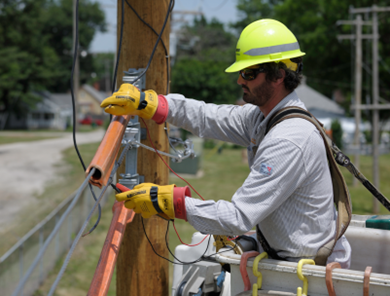
Those of us who work for electric utilities will be familiar with a saying, “Rubber Up or Cover Up,” which is a common practice when linemen or electricians work on energized overhead (OH) lines and parts at higher primary voltages, as shown in Figures 3 and 4 of Part 2. But this is seldom employed with lower secondary voltages by the same workers. Again, a lack of understanding of the hazardous nature of lower voltages is the main driver here.
For those who also work on OH secondary circuits energized at the lower voltages, the same principles apply. The lineman in Figure 9 is installing line hose, often called “eels or gut,” over the uninsulated energized conductors of a 120/240-volt single phase circuit. The center conductor is the grounded neutral conductor which doesn’t need to be insulated.
Figure 9 - Lineman Proactive Installing Line Hose
He is wearing Class zero rubber gloves rated to 1kV with leather protectors while sliding the line hose sections over the bare wires. Once the hose is in place, Figure 10 demonstrates how he can now safely take voltage readings while effectively avoiding inadvertent contact with any vulnerable parts of his body.
Figure 10 - Avoid Contact is now Ensured While Taking Voltage Reads
With this example, the worker is demonstrating excellent electrical safety practices by insulating himself from the energized parts using rubber gloves and insulated the energized parts from him with the line hose, which we call “Rubber Up and Cover Up.” By using both methods, the risk of making inadvertent contact is greatly reduced.
While Figures 9 and 10 show bare wires being temporarily insulated, similar precautions should also be used with insulated secondary OH conductors such as TriPlex or QuadruPlex service drops. The insulation on secondary service cables is rated at 600 volts, but they are constantly exposed to extreme weather elements and intense UV all year long and are often physically damaged, which compromises its ability to insulate it from a worker. At a minimum, low voltage rubber gloves with protectors should always be used when handling or touching insulated service drops that are energized.
Avoid Contact is the Only RAB or MAD That is Violated After Contact is Made
When reviewing OSHA’s 1910.269, Subpart R, Appendix B Working On Exposed Energized Parts, we find a very interesting and revealing fact regarding “Avoid Contact”. Appendix B clearly informs us that “The minimum approach distance (MAD) for this voltage range (50 to 300 volts) contains neither an electrical component or an ergonomic component.” (emphasis added)
This statement makes perfect sense because it is impossible for a directive of “Avoid Contact” to contain an ergonomic component to compensate for human errors, nor can it possess an electrical component of air, since there is no air gap.
This position is further supported by OSHA’s final rules Vol. 79, No. 70, Part II, dated April 11, 2012, with the following directive:
“The hazards posed by installations energized at 50 to 300 volts are the same as those found in many other workplaces. The employee must avoid contact with the exposed parts and the protective equipment used (such as rubber insulating gloves) must provide insulation for the voltages involved.” (emphasis added)
Unfortunately, this clarifying information is not found in the text of the regulations, forcing one to dig through hundreds of pages of the final rules to locate this informative safety nugget.
Shock Tables in 70E
I have the greatest respect for NFPA70E, but like anything else of human origin, it is not perfect. When we look closely at the shock Tables 130.4(E)(a) for AC or 130.4(E)(b) for DC, the right columns are titled “Restricted Approach Boundary.” In the title, we also find an interesting statement, “Includes Inadvertent Movement Adder,” as highlighted in Figure 11.
Due to a lack of either an ergonomic or an electrical safety factor, “Avoid Contact” is literally the only RAB or MAD that is violated only after inadvertent contact has occurred, followed by serious injury or death. This safety dilemma is further compounded when a technical definition of “Avoid Contact” is not offered in any of the regulations, standards, or codes.
Without an official definition, the worker is left to his own devices to interpret and determine what “Avoid Contact” means to him based on the common vernacular. Therefore, “Avoid Contact” is a safety directive that replaces a physical distance without any contextualization as for the purpose and conditions necessary to cross this RAB/MAD.
Humans Are Not Perfect
Some have mistakenly argued Avoid Contact implies a safety buffer because it only applies to qualified electrical workers who are trained to recognize and avoid the hazard. But training followed by a demonstration of technical skills does not guarantee the worker will never make a mistake, and that is precisely the reason for the ergonomic factor built into physical distances of the MAD/RAB. To sustain this foolish position means we must hire only perfect people as our qualified electrical workers, which we know is impossible.
One of the pioneers of human performance management is James Reason, who established twelve principles of error management that debunks this mindset. Two of Dr. Reason’s principles are, “Human error is universal and inevitable,” and, “Even the best people can make the worst mistakes.” This is attested by the unacceptable number of workplace fatalities every year of highly training and skilled qualified electrical workers.
Avoid Contact Should be Replaced or Defined
The misunderstanding and confusion demonstrated by qualified electrical workers that “Avoid Contact” means ‘Don’t Touch It’ is indicative of gaps and weaknesses in our existing regulations, standards, and codes. Furthermore, we must not place blame on the workers because the problem resides in the governance and his or her training.
However, this knowledge gap can be effectively bridged if the ambiguity is eliminated, by replacing “Avoid Contact” with a physical distance, such as 2 or 3 inches. Some employers have completely eradicated “Avoid Contact” from their electrical safety programs by replacing it with 12 inches as the MAD/RAB from 50 to 750 volts to eliminate any confusion.
An alternative to establishing a distance is the development of a clear and understandable definition for “Avoid Contact.” We must be forward-looking for interim actions and solutions, by formulating our own effective, simple, and clear definition of what “Avoid Contact” means. The following example of a definition is offered.
Avoid Contact –Taking the necessary abatement actions, such as using PPE and placing insulating material over exposed energized parts to reduce the risk and likelihood of making inadvertent contact.
Public comments (PC) have been submitted to have this definition added into the next revisions of NFPA70E and its Canadian equivalent, CSA Z462. Hopefully, the technical committees of both standards will see the value of a definition.
We Must Do Something Rather Than Nothing
Some may bristle at the idea of fabricating an unofficial definition that isn’t currently supported by any existing standards or codes, but as my good friend Professor Lanny Floyd once reminded me, “All safety regulations and standards were originally only best practices and recommendations.”
So, my rhetorical question to those who may be hesitant is, “What should we be doing in the meantime while the NFPA 70E and/or CSA Z462 technical committees ponder the changes?” Obviously, for those of us committed to reducing electrical fatalities and serious injuries, we must change our modus operandi from people who sit around and wait for others to make the necessary changes, to people who make the necessary changes for the safety of others because doing nothing is not an option.
Proactively pursuing better electrical safety protocols will invariably pay good returns on our investments with fewer deaths and a clear conscious knowing we did something positive to help turn the tide in the right direction.
If “Rubber Up or Cover Up” is effectual in minimizing inadvertent contact with higher voltage equipment, then it will be just as effective when used for lower voltage work activities. But until the governances are updated, employers cannot sit idly by and do nothing other than wait. We have a moral obligation to pursue improvements in our electrical safety programs to prevent future injuries and fatalities from a simple yet common misunderstanding that “Avoid Contact” doesn’t mean “Don’t touch it.”
NFPA 70®, National Electrical Code®, NEC® , 70E®, and Standard for Electrical Safety in the Workplace® are registered trademarks of the National Fire Protection Association, Quincy, MA.
George Cole joined the e-Hazard team in 2021 as an electrical safety instructor and consultant specializing in the electric utility industry. He has worked for the largest electric utility company in Arizona for over three decades, holding various technical roles in several departments (building electrical maintenance, T & D, radio telecommunications, electric power generation, etc.). George is currently assigned to the Palo Verde Nuclear Generating Station as their electrical safety consultant and is the “Subject Matter Expert” (SME) in all matters related to electrical safety. George holds credentials as a Certified Electrical Safety Compliance Professional (CESCP) and a Certified Electrical Safety Worker (CESW) from the NFPA and serves as a member of NFPA’s Certification Advisory Group (CAG) for the CESCP and CESW. He is also a member of the Electrical Safety Industry Working Group (IWG) within the nuclear power industry, where he is considered an electrical safety expert among his peers.